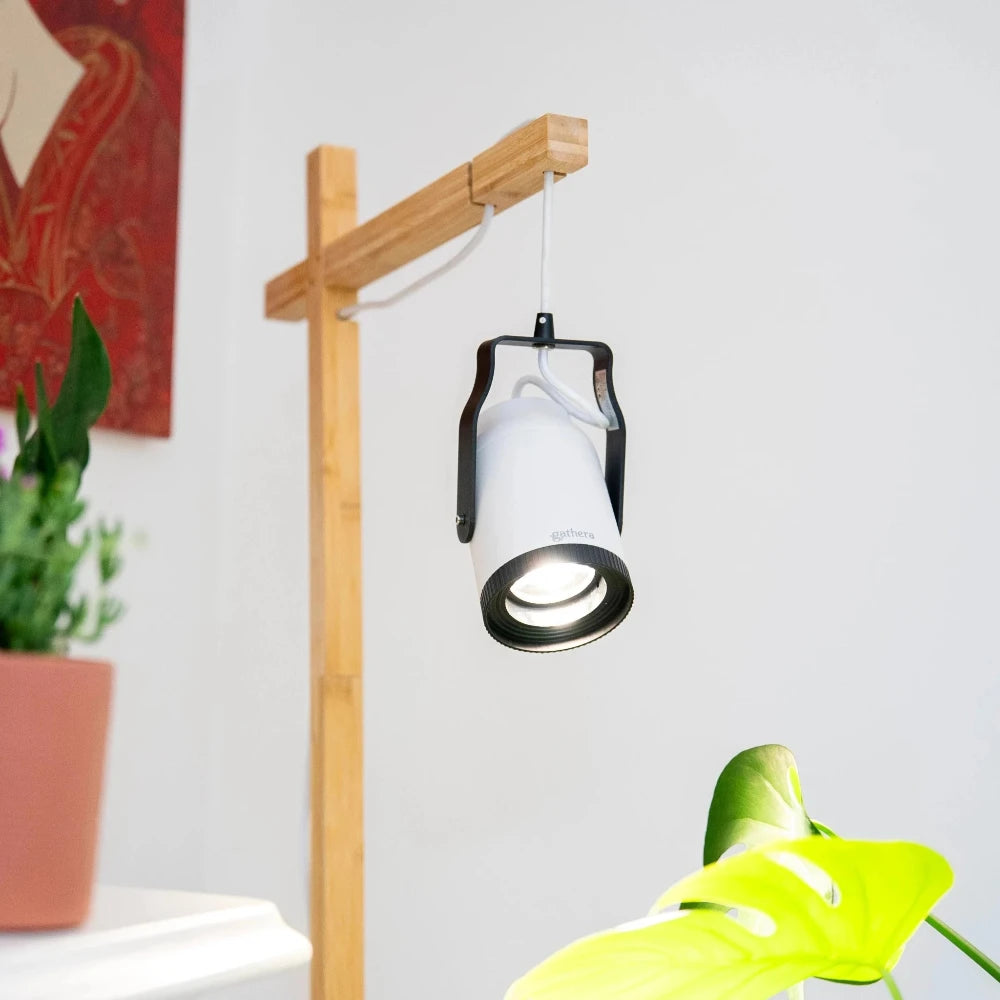
Before you buy a grow light, it helps to know whether it will really help your plants grow. Plants need particular wavelengths of light, mainly red (600 to 700nm) and blue (400 to 500nm). LED grow lights are designed to provide these wavelengths. Unlike household lights, grow lamps are tuned to the PAR scale, so the light they emit promotes plant growth effectively.
What distinguishes grow lights from sunlight?
Sunlight contains a broad spectrum of radiation, from gamma waves to long radio waves. The part we can see, the visible spectrum, is only a small slice of that.
What type of light do plants need to grow?
Plants primarily use blue and red light, between 400 and 500nm and between 600 and 700nm. They do not always use other parts of the spectrum. Every plant has slightly different needs for intensity, wavelength and exposure, but most hobbyists do not need that much detail to get great results.
Every grow light we sell at gathera has been tested to make sure it can grow plants efficiently.
What do the different wavelengths of light do?
Blue light (400 to 500nm) encourages photosynthesis and leads to bushier plants that do not stretch to find more light. It is good for growing in compact spaces.
Red light (600 to 700nm) signals to the plant that it is time to develop flowers or fruit. Plants under redder light often stretch and grow longer rather than short and bushy.
What about UV or infrared light?
UV and infrared can improve plant cell quality but are not necessary for plant growth. They do have some benefits:
UV-C can sterilise algae, bacteria and mould.
They can mildly stress a plant, which advanced growers use to their benefit. For example, stressing basil close to harvest may make it hold on to its sugars and taste sweeter.
Our grow lights are not designed to emit UV or infrared light.
Are all LED lights grow lights?
No. Different light sources produce different wavelength spectra. Daylight contains a large amount of every wavelength, while fluorescent light has a few narrow bands that combine to look white. What the common household lights have in common is that they are optimised for the human eye.
That is why a household light globe could grow a plant but most likely would not: most of the light it emits is at the wrong wavelengths. Grow lights, on the other hand, have a spectrum tuned to the PAR scale, with significant intensity in the blue or red wavelengths plants are most sensitive to.
How do you measure a grow light's effectiveness?
Grow lights are measured differently from household lights. For household lighting we use lux or lumens, which peak in the green and yellow wavelengths because humans see those most brightly. Plants reflect green light, which is why they look green to us, so those wavelengths matter less for growth. For grow lights you need to look at the amount of light between 400 and 700nm, known as the photosynthetically active radiation (PAR) range.
PAR: photosynthetically active radiation. The range of light between 400 and 700nm.
PPF: photosynthetic photon flux. The number of photons a light emits within the PAR range, measured in micromoles per second.
PPFD: photosynthetic photon flux density. How much of that light lands on each square metre, measured in micromoles per square metre per second.
DLI: daily light integral. The total amount of photosynthetically active light a plant receives in a day.
Other measurements
These are common for regular lights but are not a good guide for grow lights:
Lumens: the total visible light (to the human eye) a source emits.
Lux: the visible light that lands on each square metre.
Kelvin: the colour of the light. Warm, reddish light has lower Kelvin values and cool, bluish light has higher values.
Summary
Plants need mostly red and blue light, and grow lights are built to deliver it. Browse our full-spectrum LED grow lights, or read on: